It’s Not About “Being Guided.” It’s About Decision Quality.
The UIAGM (International Federation of Mountain Guides Associations) certification represents the highest international standard in professional mountain guiding. It requires years of technical training across rock, ice, alpine terrain, and ski mountaineering — plus formal evaluation in risk management and human factors.
But what does that mean for you as a climber or skier?
It means that the person leading your rope is not just strong — they are trained to:
- Read complex terrain in real time
- Anticipate objective hazards
- Adapt plans under pressure
- Manage group dynamics at altitude
- Make conservative decisions when necessary
And most importantly: to know when not to continue.

Risk Is Managed, Not Eliminated
Mountains will never be risk-free. Glacier travel involves crevasses. High-altitude ascents involve exposure and fatigue. Ski touring involves avalanche terrain.
The difference lies in how those risks are managed.
On a peak like Mont Blanc, crossing the Goûter Couloir safely depends on timing, snow stability, and understanding how conditions evolve overnight. On a 6,000-meter Andean objective, managing wind exposure and summit timing can be the difference between a controlled descent and a deteriorating situation.
A certified guide evaluates:
- Weather models and local patterns
- Snowpack structure and recent wind loading
- Team pace versus altitude progression
- Exit options if conditions shift
The goal is not heroics. It is controlled, informed movement.
Pacing Is a Technical Skill
One of the most underestimated aspects of mountaineering is pacing.
At high altitude, efficiency matters more than speed. Moving too fast early on leads to dehydration and premature fatigue. Moving too slow exposes the team to changing weather and unstable snow later in the day.
A UIAGM / IFMGA guide structures the ascent rhythm around:
- Sustainable breathing patterns
- Strategic hydration stops
- Efficient transitions (skins to crampons, rope systems, etc.)
- Turnaround times defined before summit fever takes over
This rhythm is often the difference between a successful summit day and an exhausted retreat.

Terrain Reading: The Invisible Craft
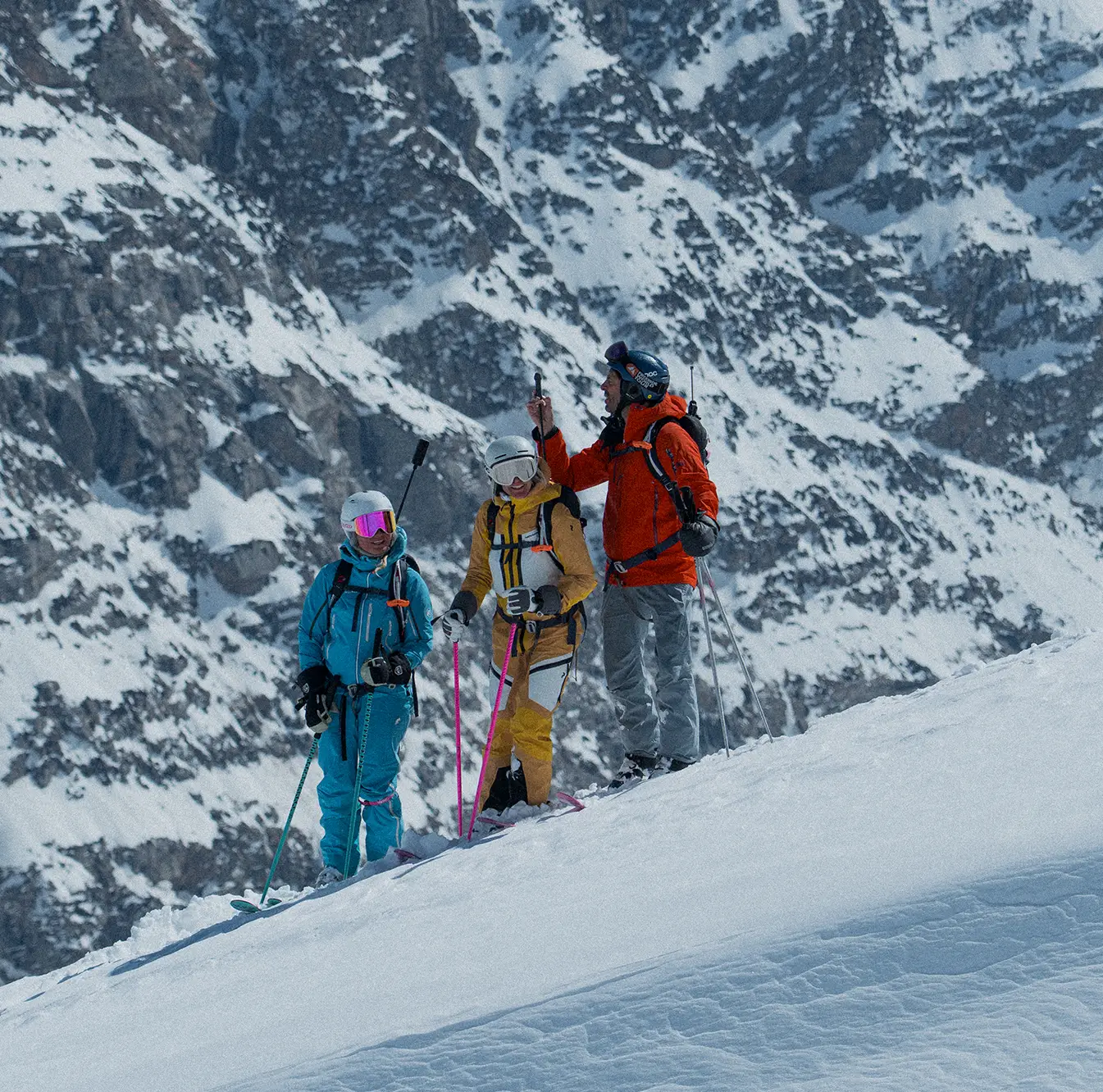
On ski expeditions — whether in the Alps or on Chilean volcanoes — terrain rarely announces its hazards clearly.
Wind can create slabs that are invisible to the untrained eye. Penitentes fields can multiply effort at altitude. Glacier bridges weaken as temperatures rise. A ridgeline that appears straightforward can funnel wind in unpredictable ways.
Professional guides are trained to interpret subtle signs:
- Snow texture changes under skis
- Micro-topography that traps wind-loaded snow
- Serac fall zones
- Cornice formations on ridges
This continuous terrain analysis happens silently, step after step.
Adaptability Is the Real Skill
Mountains rarely follow the plan exactly as written.
A storm arrives earlier than forecast.
A team member feels altitude more intensely than expected.
Snow conditions shift overnight.
The true value of a certified guide lies in adaptability. Changing objectives. Adjusting routes. Shortening summit days. Extending acclimatization. Choosing quality and safety over ego.
On multi-day expeditions, this flexibility often determines whether the experience feels stressful — or smooth and purposeful.

You Learn More Than You Think
Climbing or skiing with a UIAGM / IFMGA guide is not a passive experience.
You begin to understand:
- How weather windows are selected
- Why certain ridges are chosen over others
- How avalanche terrain is evaluated
- When to push and when to turn back
Over time, participants develop sharper judgment, stronger self-awareness at altitude, and better mountain intuition.
The summit becomes part of the experience — not the only goal.
The Difference You Feel
The difference is subtle but profound.
The rope feels organized.
The transitions feel smooth.
The plan makes sense.
The pace is sustainable.
The decisions are calm.
You move through complex terrain with clarity rather than uncertainty.
And that changes the mountain entirely.

Our guided expeditions
If you are considering a high-altitude ascent or alpine ski objective, choose not just the mountain — but the standard by which you approach it.
Because in the mountains, how you climb matters as much as where you stand.